
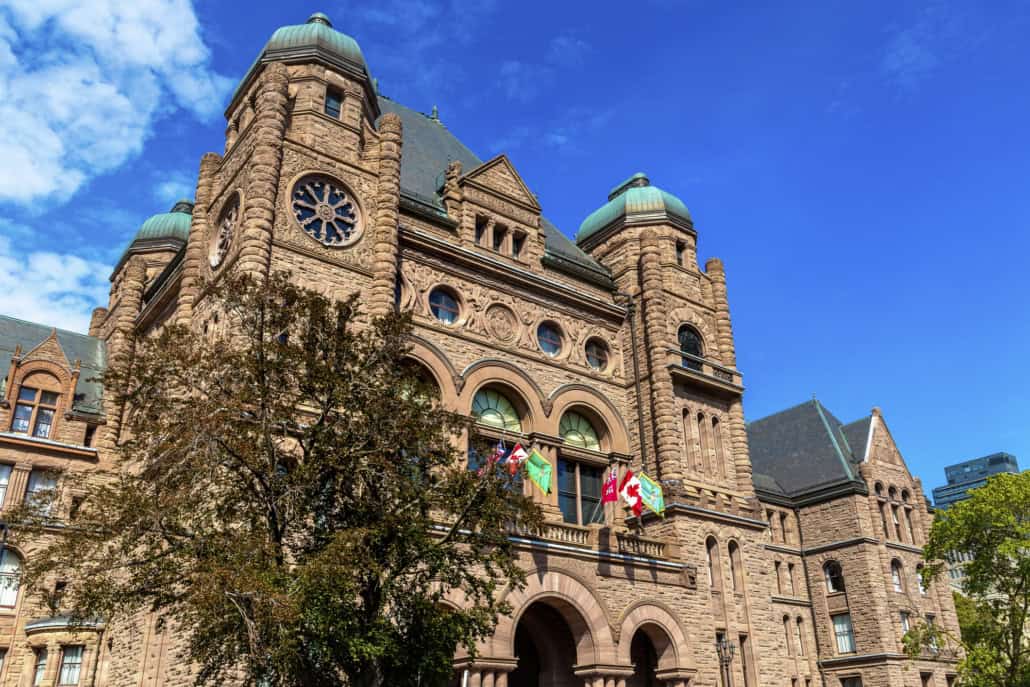
2026 Ontario Fall Economic Statement offers tax cut for business, projects higher deficits
The Canada-U.S. trade war was always going to inflict significant economic casualties on this side of the border—and provincial balance sheets would not be spared. Ontario’s 2026 Fall Economic Statement reflects the degree to which this province is feeling fiscal pain.
As Minister of Finance Peter Bethlenfalvy explained at Queen’s Park: “Ontario continues to face significant economic uncertainty driven by U.S. tariffs on Canada, but our government has a plan to protect workers, businesses and communities while building a stronger economy for the future”, adding that “… while deficits are not desirable in the long term, they are necessary in the current environment. As we have shown, our government will continue investing to protect our economy.”
His speech underscored the government’s focus on fiscal sustainability, but its roadmap doesn’t include a path to a balanced budget anytime in the next few years. At this stage, Ontario could be running deficits for the foreseeable future if trade tensions with the U.S. persist and macroeconomic factors such as surging inflation and the Middle East conflict put mounting pressure on economies worldwide.
How deep in the fiscal hole does the province continue to slide? Bethlenfalvy announced that the deficit is projected to surge to $16.9 billion in the 2026–27 fiscal year, decreasing to $12.7 in 2027-28 and to $6.7 billion in 2028–29. Ontario is poised to get back into the black in 2029–30, but there’s little faith the province’s near-term deficit projections will hold, barring an unlikely 180-degree shift in Canada-U.S. trade relations. In the 2026 Ontario Budget, the provincial deficit for 2026–27 was pegged at $13.8 billion (which was $6 billion more than projected in the 2025 Fall Economic Statement) and $6.1 billion in 2027–28.
That’s a $3 billion projected spike in the deficit for this year—in just seven months. It’s worth noting that a sizeable portion of the deficit hike is due to a $3.6 billion increase in the province’s fiscal reserve fund over the next three years.
Economic growth is also projected to slow to a crawl. Real GDP for 2026 is now forecast to increase by 0.5 per cent in 2026 (down from projected growth of 1 per cent in the budget) and 1.5 per cent in 2027 (down slightly from a projected 1.7 per cent). Whatever fiscal leeway Ford’s government may once have had has all but vanished. Now, the threat of a tariff-induced recession looms large.
Perhaps that’s why the Tories have continued to drive home messaging around ‘protecting Ontario workers, businesses and communities’ as they continue to play economic defence. It’s also the likely reason why the Fall Economic Statement is light on new measures, with the most significant announcement geared towards the province’s business audience.
Indeed, nearly all of the policy highlights from the Statement had been announced previously, including the headline Ontario Competitiveness Tax Cut. The $8 billion relief measure aligns with the recently announced federal Productivity Mega Deduction and is in addition to write-off measures announced in Ontario’s Budget 2026. This new permanent tax cut allows businesses to deduct 100 per cent of the value of a wider range of capital investments including:
- Manufacturing and processing machinery and equipment, certain clean technology property, zero-emission vehicles, greenhouse buildings, and productivity enhancing assets
- Certain qualifying new vehicles assembled in Canada
- Certain liquefaction equipment used in liquefied natural gas facilities
- Canadian development expenses
- Manufacturing and processing buildings, with a phase-out after 2029
- Accelerated depreciation from 4 per cent to 10 per cent for purpose-built rental housing for construction completed before January 1, 2036
- Accelerated first-year deductions of as much as three times the regular amount for most other depreciable assets with a phase-out after 2029
As with the Productivity Mega Deduction, the Ontario Competitiveness Tax Cut applies to eligible capital assets acquired on or after September 15, 2026.
Other new or previously announced measures in the 2026 Ontario Fall Economic Statement include:
- A restoration of eligible expenditures under the Ontario Research and Development Tax Credit and the Ontario Innovation Tax Credit. The government estimates the measure will provide more than $50 million over three years in additional R&D tax support to qualifying businesses
- $8.7 billion in federal-provincial commitments to modernize and enhance Ontario’s steel, automotive and critical minerals sectors. The plan is designed to support the tariff-impacted sectors, while helping key industries transition to a focus on advanced manufacturing, defence, energy, electric vehicles and strategic infrastructure
- Updated eligibility for the Ontario Computer Animation and Special Effects (OCASE) Tax Credit to support Ontario’s film and television sector. The government is proposing a change of eligibility for the 18 per cent refundable corporate income tax credit, offering it to film and television producers only
- A pause on the $4 billion Protect Ontario Investment Fund
In all, the province is attempting to preserve program funding and drive new business investment in an increasingly difficult economic environment. We can only hope that an end to Canada-U.S. trade tensions is in sight to return Ontario to robust growth and a renewed focus on budgetary balance.
Armando Iannuzzi, Co-Managing Partner
For more information on measures announced in Ontario’s 2026 Fall Economic Statement, contact a member of the KRP LLP team today.
